5 Healthy Food Swaps: How to Spot Hidden Sugar on Food Labels
If you’re a regular reader of my work, chances are you already do what you can to fill your shopping trolley with healthy food.
But let’s be honest: most of us are guilty of the occasional quick trolley dash. We grab the foods we always buy, make a few snap decisions and assume that the products with healthy-looking packaging must be good choices.
Sometimes, though, things aren't quite as they seem.
From breakfast cereals and yoghurts to crackers, sauces and snack bars, food labels can be confusing. And with more products than ever shouting about being “high protein”, “low fat”, “no added sugar” or “reduced sugar”, it can be difficult to know what you're actually buying.
So, let's take a closer look.
Don't be fooled by the health claims
Sugar is one of the ingredients I’m always looking out for when I'm shopping, particularly in foods that we don't necessarily associate with sweetness.
It is cheap, palatable and often added to foods in surprisingly large quantities.
But one of the biggest problems is the language used on food packaging.
You might see:
No added sugar
Less sugar
Reduced sugar
Low sugar
These don't all mean the same thing.
“Low sugar” is the one to look out for if you're specifically looking for a low-sugar product. Under UK food labelling rules, a solid food can generally only be described as “low sugar” if it contains no more than 5g of sugars per 100g.
“Less sugar” and “reduced sugar” are comparative claims. They simply mean that the product contains less sugar than a comparable product – not necessarily that it contains very little sugar.
And “no added sugar” doesn't mean sugar-free.
A product can contain naturally occurring sugars from ingredients such as dates, dried fruit or fruit juice concentrates and still be relatively high in total sugars.
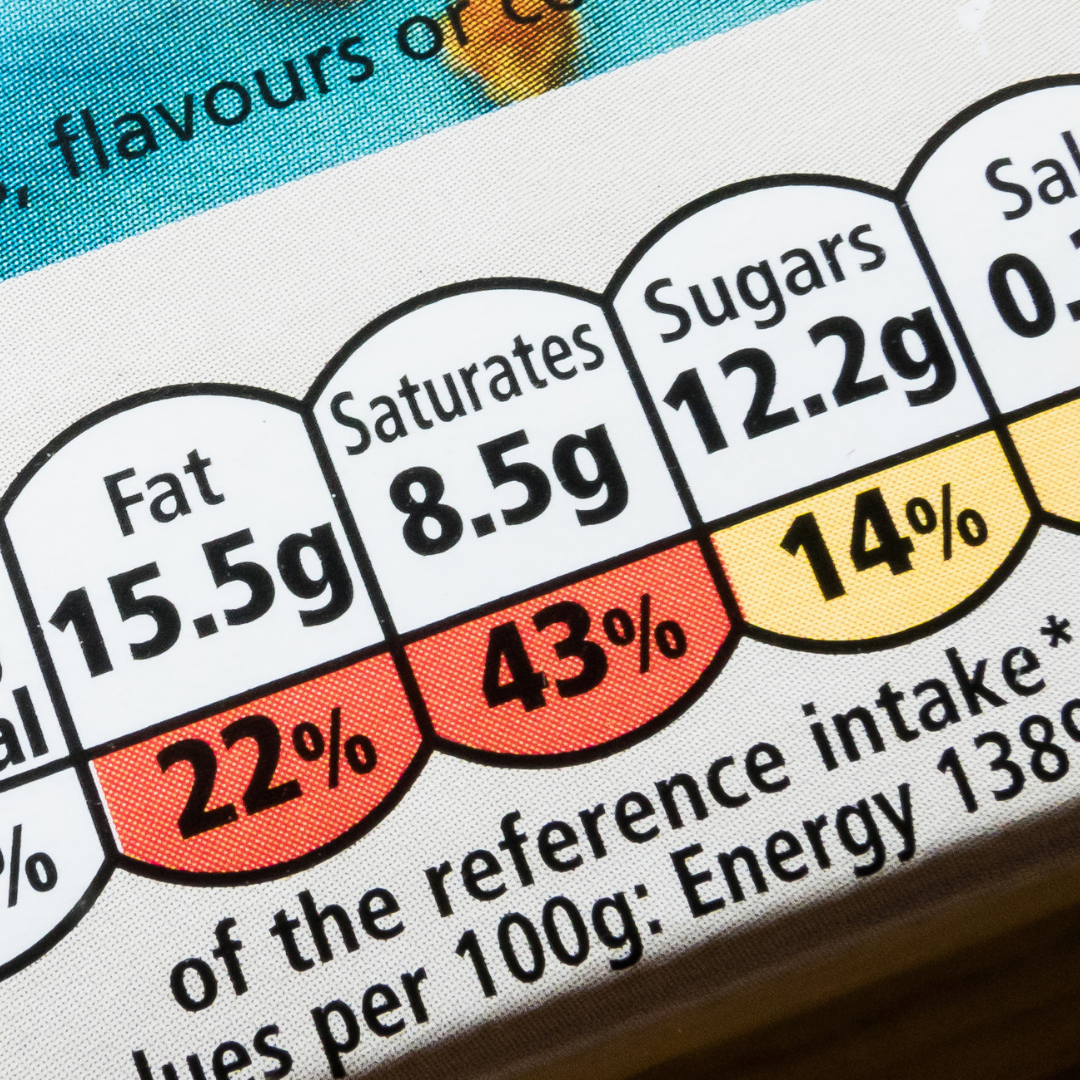
So don't just look at the big claim on the front of the packet. Turn it around and check the nutrition information.
The protein halo
Protein has become the new star of the food marketing world.
And yes, protein is important. We need it to build and repair muscles and tissues, and getting enough becomes increasingly important as we get older.
But “high protein” doesn't automatically mean healthy.
I've seen breakfast cereals proudly displaying “high protein” claims while containing around 21g of sugar per 100g. That's getting very close to the threshold for a food to be considered high in sugar.
This is where the nutrition label becomes your friend.
A product can be high in protein and high in sugar at the same time.
The same applies to products marketed as “skinny”, “light”, “low fat” or “healthy”.
Don't let the health claim do your thinking for you.
We've been afraid of fat for too long
For years, we've been encouraged to choose low-fat products in the belief that fat was the problem.
But fat isn't the enemy.
We need dietary fat for essential functions throughout the body. It provides essential fatty acids, including omega-3 and omega-6 fats, and helps us absorb the fat-soluble vitamins A, D, E and K.
Fat also adds flavour and can help us feel satisfied after eating.
The problem is that when fat was removed from many processed foods, something had to replace it to make the products palatable. In many cases, that meant more carbohydrate and sugar.
We've now gone from the “low fat” era to the “high protein” era, but the same principle applies.
A healthy-looking product isn't necessarily a healthy product.
Read the ingredients list
One of the easiest ways to spot hidden sugar is to look at the ingredients list.
Ingredients are listed in descending order by weight, so if sugar appears near the top of the list, there is likely to be a significant amount in the product.
And sugar doesn't always appear as the word “sugar”.
You might see:
Glucose syrup
Fructose
Dextrose
Honey
Fruit juice concentrate
Syrups
Dried fruit
These ingredients aren't necessarily unhealthy in themselves, but they all contribute to the total amount of sugar you're eating.
This is why checking the nutrition panel as well as the ingredients list is so useful.
5 simple swaps for your shopping trolley
You don't need to throw everything out of your kitchen cupboards and start again.
Instead, try making a few simple swaps.
1. Swap diet yoghurts for natural or Greek yoghurt
Rather than choosing a yoghurt because it says “low fat” or “high protein” on the front, try natural or Greek yoghurt.
It's a simple, versatile source of protein and you can add your own berries, nuts and seeds for flavour, fibre and healthy fats.
2. Swap sweetened muesli for a lower-sugar option
Muesli can sound like a wonderfully healthy breakfast, but some varieties contain plenty of dried fruit and added sugars.
Check the label and look for a lower-sugar granola or muesli, ideally with plenty of nuts, seeds and wholegrains.
Better still, make your own so you know exactly what's going into it.
3. Swap “skinny” bars for nuts or oat-based snacks
Those individually wrapped “skinny” or low-calorie snack bars might look like the healthy option, but some can contain around 40–50g of sugar per 100g.
Instead, try a handful of nuts, a simple oat-based bar with a short ingredient list, or make your own.
4. Swap sweet chilli sauce for sriracha
If you're looking for a little heat, sriracha can be a useful alternative to sweet chilli sauce, which can contain a surprising amount of added sugar.
As always, check the label because recipes vary between brands.
5. Swap sugary pasta sauces for passata or tinned tomatoes
This is one of my favourite easy swaps.
Rather than buying a ready-made pasta sauce that may contain added sugar, start with a carton of passata or a tin of tomatoes.
Add garlic, herbs, olive oil and whatever vegetables you have lurking in the fridge.
Simple, delicious and you know exactly what's in it.
Your shopping trolley is in your hands
You don't need to become obsessed with food labels or spend hours comparing every product on the supermarket shelf.
But learning to look past the marketing claims and check the nutrition panel and ingredients list can make a big difference.
“High protein” doesn't automatically mean healthy. “Low fat” doesn't necessarily make something a better choice. And “no added sugar” doesn't mean sugar-free.
The best place to start is with plenty of minimally processed foods: vegetables, fruit, wholegrains, beans and pulses, nuts and seeds, eggs, fish, meat, natural yoghurt and other nourishing basics.
Use your label-reading skills to choose the best options when you do buy packaged foods.
Turn it around. Read the label. Don't let the front of the packet make the decision for you.
About the author:
Jane McClenaghan is renowned for her down-to-earth, evidence-based approach to nutrition, making healthy eating practical and achievable for everyone.
With over 25 years of experience delivering group sessions for corporate clients and one-to-one consultations, she specialises in women’s health and has helped thousands of people transform their wellbeing through better nutrition.
As the author of two best-selling books and a familiar voice on local radio, Jane is passionate about translating the science of nutrition into real food on your plate and empowering others to make lasting, positive changes for their health.
Get in touch